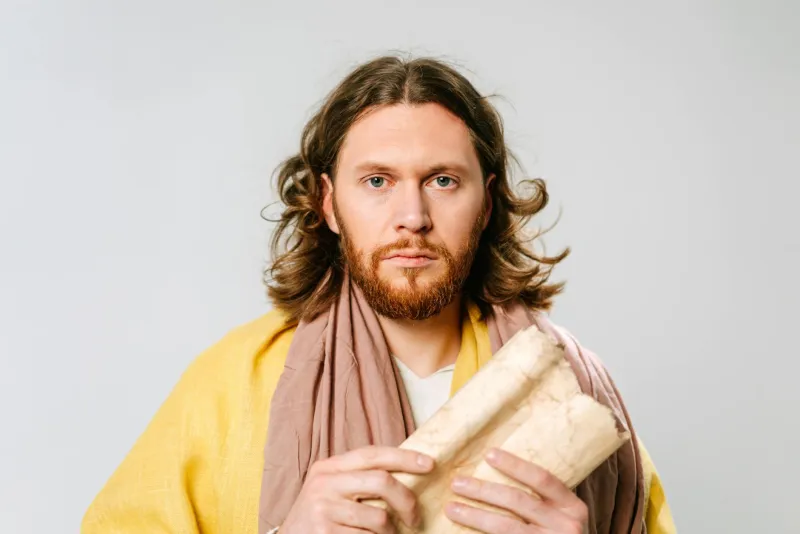
Marcus Aurelius Had a Morning Routine Too
Every productivity guru who's ever told you to "optimize your morning" is plagiarizing a Roman emperor. Marcus Aurelius, writing around 170 CE, documented a daily routine that included meditation, journaling, cold exposure, and mental exercises designed to build resilience against life's inevitable setbacks. His "Meditations" reads like a Bronze Age version of a modern self-help bestseller, complete with bite-sized wisdom and actionable advice.
 Photo: Marcus Aurelius, via fourminutebooks.com
The difference? Aurelius never monetized his morning routine or promised it would make anyone rich. He was documenting personal practices during one of the most turbulent periods in Roman history, when plague, war, and political instability made individual self-control feel like the only reliable constant in an unreliable world.
Sound familiar? Every time society feels like it's falling apart, people rediscover the ancient promise of self-improvement: if you can't control the world, at least you can control yourself. The 4,000-year history of personal development culture reveals a pattern that modern wellness influencers would recognize immediately—and probably prefer you didn't notice.
Ancient China Invented Life Coaching
Confucius wasn't just a philosopher; he was history's first professional life coach. Around 500 BCE, he developed systematic methods for personal cultivation that promised to transform ordinary people into exemplary citizens. His approach included daily reflection practices, ethical guidelines, and social skills training that would fit comfortably in any modern leadership development program.
 Photo: Confucius, via classroomclipart.com
The Confucian self-improvement system emerged during China's Spring and Autumn period, an era of political fragmentation and social upheaval when traditional institutions were collapsing. People who couldn't rely on stable governments or predictable social structures turned inward, seeking personal practices that could provide security when external systems failed.
Confucian self-cultivation wasn't just about individual betterment—it was about preparing for a world where personal character might be the only reliable foundation for success. The same psychological needs that drove ancient Chinese scholars to develop systematic self-improvement practices are driving modern Americans to spend $13 billion annually on wellness products and services.
Victorian England's Productivity Obsession
The 19th century witnessed history's first true self-help publishing boom. Books like Samuel Smiles' "Self-Help" (1859) and Horatio Alger's rags-to-riches novels created a template for personal development literature that hasn't changed in 150 years: identify a problem, promise a solution, provide a system, and insist that failure to improve reflects personal weakness rather than systemic barriers.
Victorian self-help culture emerged during rapid industrialization, when traditional ways of life were being destroyed by technological change. People who had lived in stable agricultural communities for generations suddenly found themselves in crowded cities, competing for factory jobs, and navigating social structures that changed faster than anyone could adapt to them.
The Victorian response was to reframe social disruption as individual opportunity. If the old world was disappearing, the new world would belong to people who could improve themselves fast enough to keep up. Personal development became a survival strategy disguised as moral uplift.
The Great Depression's Self-Improvement Boom
Dale Carnegie's "How to Win Friends and Influence People" wasn't published during economic prosperity—it hit bestseller lists in 1936, when unemployment was still above 15% and millions of Americans were struggling to rebuild their lives after financial collapse. Carnegie's advice about positive thinking and social skills offered psychological tools for navigating a world where traditional career paths had evaporated.
 Photo: Dale Carnegie, via dalecarnegie.com.sg
The book's popularity reveals something crucial about self-improvement culture: it always promises individual solutions to collective problems. Carnegie wasn't addressing the structural economic issues that caused the Depression; he was teaching people how to succeed within a broken system by developing better personal strategies for dealing with uncertainty and competition.
This pattern repeats throughout history. Self-help booms don't happen during stable, prosperous periods when social systems work reliably. They explode during crises, when people need psychological frameworks for coping with circumstances beyond their control.
Ancient Stoicism Meets Modern Biohacking
Today's biohacking movement—with its emphasis on cold showers, intermittent fasting, and optimized sleep—is essentially ancient Stoicism with better marketing and more expensive equipment. Stoic philosophers like Epictetus developed systematic practices for building physical and mental resilience, including deliberate discomfort exercises, dietary restrictions, and mindfulness techniques that modern practitioners would immediately recognize.
The Stoics lived through the collapse of the Roman Republic and the early chaos of the Empire, when political violence and social instability made personal resilience a matter of survival. Their self-improvement practices weren't lifestyle choices—they were practical tools for maintaining sanity and effectiveness when external circumstances became unpredictable and dangerous.
Modern biohackers are responding to different stressors—economic uncertainty, technological disruption, climate anxiety—but they're using remarkably similar tools. The promise remains identical: if you can optimize your individual performance, you can maintain control and success regardless of what happens to the larger world.
The Anxiety Economy
Self-improvement culture has always been an anxiety economy. It thrives during periods when people feel like traditional institutions can't provide security, meaning, or clear paths to success. Ancient Romans turned to Stoicism during political chaos. Medieval Christians developed systematic spiritual practices during plague years. Victorians embraced self-help during industrial disruption.
The content changes, but the psychological function remains constant: self-improvement offers the illusion of control when everything else feels chaotic. It provides actionable steps when larger problems seem unsolvable. Most importantly, it reframes structural challenges as personal opportunities, making individuals responsible for adapting to circumstances they didn't create and can't change.
This isn't necessarily cynical—personal practices can genuinely help people cope with difficult circumstances. But the historical pattern reveals something uncomfortable about how self-improvement culture functions: it often serves as a pressure valve that channels legitimate frustration with systemic problems into individual behavior modification projects.
The Same Pitch, Different Podcast
Every generation rediscovers the same basic self-improvement promise: you are the problem, but you are also the solution. Ancient Stoics called it "focusing on what you can control." Medieval Christians framed it as spiritual discipline. Victorians marketed it as character building. Modern wellness culture packages it as optimization and life hacking.
The delivery mechanisms evolve—from scrolls to books to podcasts to apps—but the core message never changes. Individual effort can overcome any obstacle. Personal development can solve any problem. The right morning routine, mindset, or systematic approach can provide security and success regardless of external circumstances.
This message resonates across millennia because it addresses real psychological needs. People do need practices for managing stress, building resilience, and maintaining motivation during difficult periods. The problem isn't that self-improvement doesn't work—it's that it works just well enough to distract from larger questions about why so many people need systematic personal optimization just to survive ordinary life.
History's Most Consistent Industry
The self-improvement industry is humanity's most consistent business model. It has survived the collapse of empires, religious reformations, technological revolutions, and economic depressions without ever fundamentally changing its product offering. Ancient Roman Stoics and modern productivity gurus are selling the same thing: the promise that individual effort can provide security in an insecure world.
The 4,000-year track record suggests this isn't a bug—it's a feature. Self-improvement culture persists because it addresses permanent aspects of human psychology rather than temporary social conditions. People will always want more control over their lives, better strategies for handling stress, and practical tools for navigating uncertainty.
The historical pattern also suggests that self-improvement booms are leading indicators of social instability rather than solutions to it. When personal development culture explodes, it usually means the existing social contract is breaking down and people are preparing to fend for themselves.
Your meditation app and morning routine aren't just personal choices—they're archaeological evidence of a civilization under stress, using the same coping mechanisms that humans have developed and redeveloped for four millennia. The only thing that's changed is the subscription model.