History's Most Dangerous Sentence: 'We Are the First Free People'
History's Most Dangerous Sentence: 'We Are the First Free People'
There is a sentence that has appeared, in various forms, in the founding documents, public speeches, and national mythologies of at least a dozen civilizations over the past 2,500 years. It goes something like this: We are the first people in history to have achieved genuine freedom, and the world should look to us as its model.
Athens said it. Rome said it. 17th-century England said it. Revolutionary France said it. The United States has been saying it, in one form or another, since 1776.
Every single one of those societies, at the moment of saying it, was doing things that looked nothing like freedom to a significant portion of the people inside it — and to virtually everyone outside it. This is not a coincidence. It is a pattern. And it's the kind of pattern that five thousand years of recorded history is uniquely positioned to illuminate.
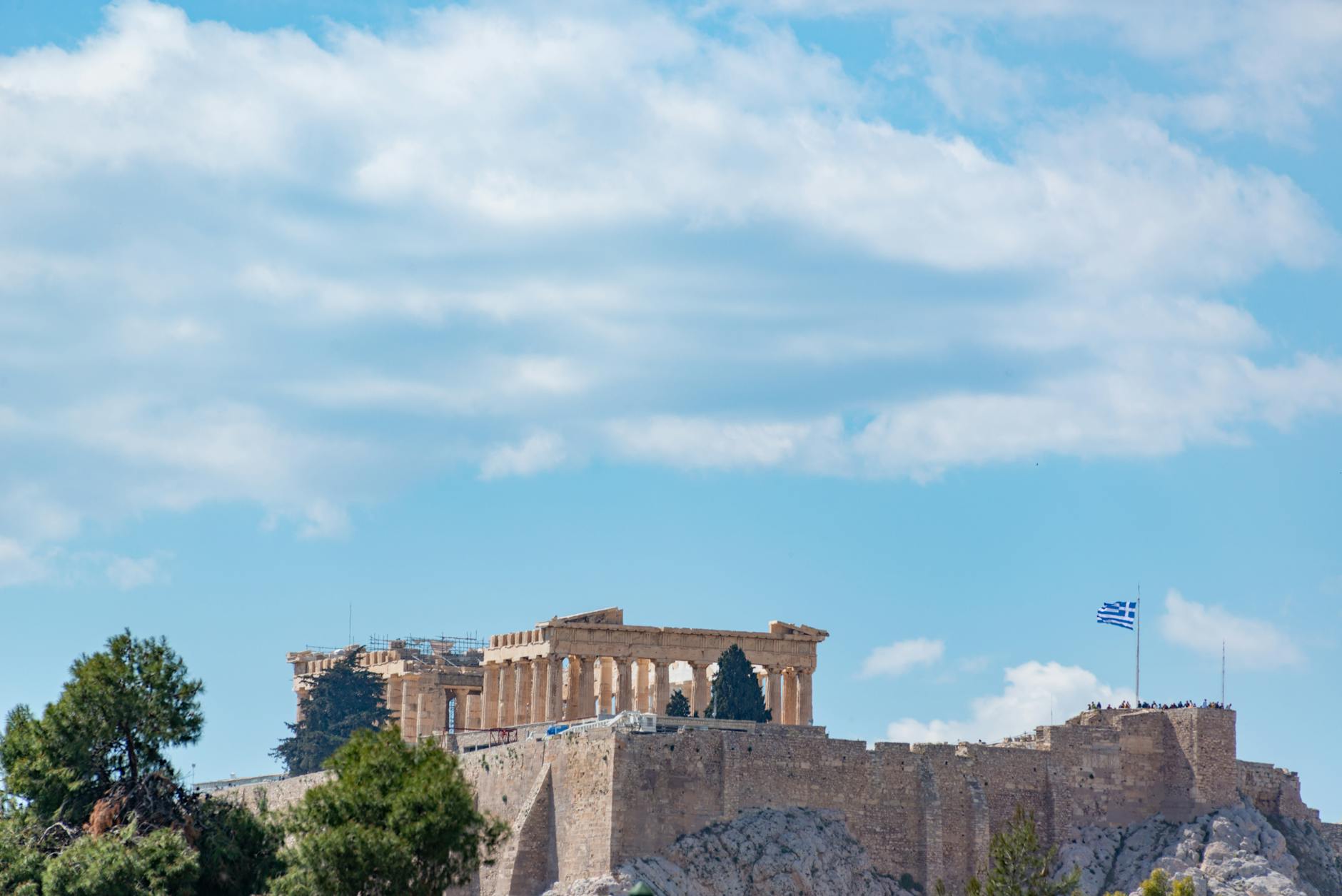
Athens: The Original Draft
The Athenian statesman Pericles delivered his famous funeral oration in 431 BCE, at the outset of the Peloponnesian War. It is one of the most celebrated political speeches in Western history, and it is a masterpiece of democratic self-description. Athens, Pericles says, "does not copy the laws of neighboring states" — it is the model, not the student. Its constitution "favors the many instead of the few." Its citizens live in freedom and openness. Other Greek cities should look to Athens as "the school of Hellas."
At the time of this speech, Athens operated one of the largest slave economies in the ancient world. Estimates suggest that enslaved people constituted between 30 and 40 percent of the population of Attica. Women could not vote, hold property, or participate in public life in any meaningful way. Resident foreigners — the metics, many of whom had lived in Athens for generations and contributed substantially to its economy — had no political rights whatsoever.
Pericles was not lying, exactly. He was describing a genuine and historically significant expansion of political participation — for Athenian-born men of citizen status. That was real. But the framing — "we are free, therefore we are the model" — required not seeing the majority of people living within Athens's borders. The rhetoric of freedom and the reality of exclusion coexisted not because Athenians were uniquely hypocritical, but because the sentence "we are free" contains a hidden variable: we means something much smaller than it sounds.
The Roman Variation
Rome's founding mythology was explicitly a freedom story. The Republic was born when the Romans expelled their last king, Tarquinius Superbus, in 509 BCE. Libertas — liberty — became one of Rome's central civic values, personified as a goddess, stamped on coins, invoked in every major political speech for the next five centuries.
The Roman orator Cicero, writing in the first century BCE, described Roman liberty as the defining characteristic that separated Romans from the barbarian peoples they governed. Roman law, Roman institutions, Roman freedom — these were gifts Rome was bringing to the world through conquest. The provinces weren't being subjugated; they were being civilized.
This is the move. This is the specific psychological mechanism that turns "we are free" into "therefore what we do is fine." If your freedom is not just a political arrangement but a civilizational achievement — something that marks you as more fully human than the people who don't have it — then spreading your civilization by force becomes not conquest but liberation. The people being conquered should, in this framework, be grateful.
Cicero believed this. He was not performing cynicism. He was expressing the sincere conviction of a man whose entire self-concept was built around Roman liberty, and who had genuinely never been asked to see the system from the outside.
17th-Century England and the Portable Myth
The English Civil War (1642–1651) and the Glorious Revolution of 1688 produced a body of political writing that would directly shape the American founders — and that repeated the Athenian and Roman pattern with remarkable fidelity.
John Locke's Two Treatises of Government (1689) articulated a theory of natural rights and political liberty that was genuinely revolutionary in its implications. Government exists to protect life, liberty, and property. When it fails, the people have the right to dissolve it. This was radical stuff.
Locke also invested in the Royal African Company, which held a monopoly on the English slave trade, and helped draft the Fundamental Constitutions of Carolina, which explicitly protected the institution of slavery. His theory of natural rights contained an asterisk — it applied to people with property, which in practice meant people of a specific race and class.
This is not presented here to cancel Locke. It's presented because the gap between his theory and his practice illustrates something important: the "we are free" sentence doesn't require bad faith. It requires a definition of "we" that the speaker has never examined.
Revolutionary France and the Guillotine Problem
The French Revolution produced the most universalist freedom rhetoric in history. The Declaration of the Rights of Man and of the Citizen (1789) didn't say "the rights of Frenchmen" — it said the rights of man. Liberty, equality, fraternity. Not for this nation. For humanity.
Within five years, the Revolution had executed somewhere between 17,000 and 40,000 people (depending on how you count), most of them French citizens, many of them peasants and workers rather than aristocrats. The Reign of Terror was conducted in the name of liberty. Robespierre, who sent thousands to the guillotine, was a genuine idealist who believed he was protecting the Revolution from its enemies.
The French case is the starkest example of the mechanism because the gap between the rhetoric and the reality was so compressed in time. The same document that declared universal human rights was being cited within years to justify mass killing. The freedom story didn't produce the violence despite its universalism — it produced it because of it. If you are fighting for the freedom of all humanity, then the people who oppose you are opposing humanity's freedom, which makes them something less than fully human, which makes eliminating them something other than murder.
The American Version
The United States was founded on the most explicit version of this story in history. Jefferson's "all men are created equal" was not a description of existing conditions — it was a declaration of founding principle, an aspiration written in the present tense. The founders knew the gap between the principle and the reality. Many of them found that gap uncomfortable. None of them closed it at founding.
What followed was 246 years of American history in which the "we are free" sentence has done genuine good — inspiring real expansions of rights, real democratic innovations, real political courage — and has also, repeatedly, been used to justify things that looked nothing like freedom: slavery, indigenous dispossession, Jim Crow, overseas empire, mass incarceration.
This is not an argument that America is uniquely bad. It is an argument that America is doing exactly what Athens, Rome, England, and France did — which is to say, it is being human.
What the Pattern Tells Us
The psychological mechanism is consistent across all five cases. It has three steps:
- A society achieves a genuine expansion of freedom for some people.
- It builds a national identity around that achievement, framing it as total and universal rather than partial and ongoing.
- The gap between the framing and the reality becomes invisible to those inside the "we" — and is used to justify behavior toward those outside it.
The Clio Method's whole argument is that human psychology hasn't changed in five thousand years. The experiment isn't running on college students — it's running on every civilization that has ever existed. And the data from that experiment is pretty clear: the sentence "we are the first free people" is not a description. It's a warning sign.
The societies that have done the most with freedom are the ones that treated it as an unfinished project rather than an accomplished fact. The ones that treated it as accomplished tended to stop working on it — right around the time they started using it to explain why other people's problems were those other people's fault.
Five thousand years. The data's right there.