The Moral Panic Factory Has Been Running Nonstop Since 100 BC

Somewhere right now, a school board meeting is getting loud. Someone is standing at a microphone, voice cracking with genuine distress, warning that the wrong books — or the wrong pronouns, or the wrong music, or the wrong TikTok dances — are going to hollow out the next generation if decent people don't act immediately. The room is split. People who've been neighbors for twenty years are suddenly enemies.
Feel familiar? It should. This meeting has been happening, in various languages and costumes, for roughly two thousand years. The script is older than the United States by about eighteen centuries, and the Romans didn't even write the first draft.
Meet Cato the Elder, America's Spiritual Ancestor
In the second century BC, Rome was winning. Military victories were piling up, wealth was flooding in from conquered territories, and the city was becoming cosmopolitan in ways that made certain powerful Romans deeply, visibly uncomfortable. Chief among them was Marcus Porcius Cato — Cato the Elder — a man so devoted to traditional Roman values that he essentially made traditionalism his entire personality and then ran for office on it.
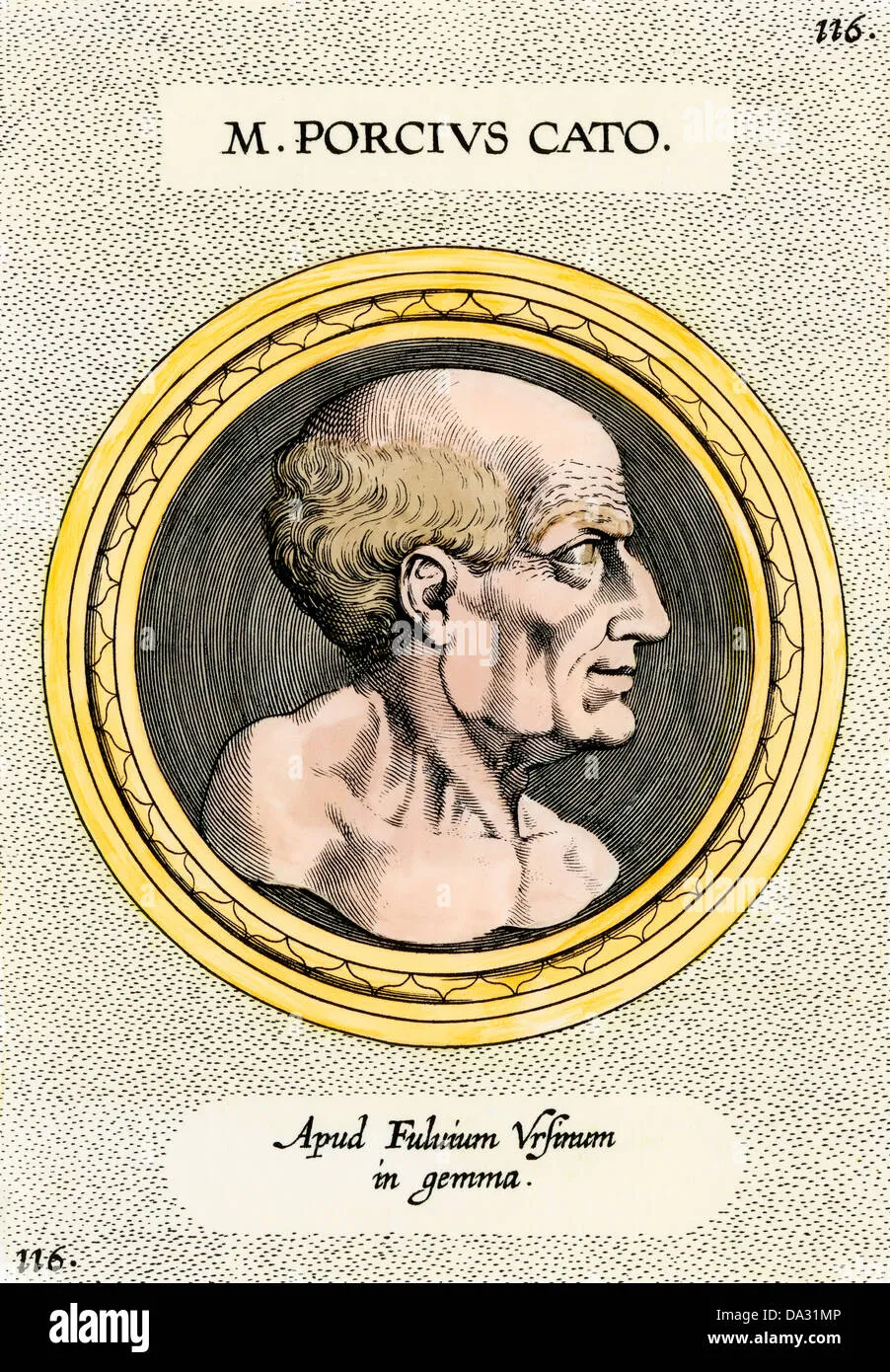 Photo: Marcus Porcius Cato, via c8.alamy.com
Cato's specific villain was Greek culture. Greek philosophers were teaching in Rome. Roman aristocrats were sending their sons to study in Athens. Greek aesthetics were showing up in Roman art, Roman dinner parties, Roman fashion. And Cato was convinced — loudly, publicly, relentlessly convinced — that this foreign influence was rotting Roman virtue from the inside out.
He held actual political power as censor, which in Rome meant he could regulate public morality and tax behavior he considered decadent. He used it. He taxed luxury goods. He expelled philosophers from the city. He gave speeches that were essentially the second-century BC version of 'this country isn't what it used to be.'
Here's the thing history records clearly: Roman civilization did not collapse because of Greek philosophy. It thrived for another several centuries after Cato's panic. The thing he was protecting 'Roman virtue' against was, in many ways, what made Rome great.
The panic wasn't about the actual threat. It was about Cato — and people like him — needing to own the definition of what counted as properly Roman.
The Mechanics of Manufactured Outrage
This is where psychology becomes more useful than political science. Human beings have a documented, consistent, cross-cultural tendency to use moral enforcement as a dominance behavior. Psychologists call it 'moral grandstanding' — the use of public ethical displays not primarily to solve a problem but to establish one's own status within a group.
The research on this is pretty clear. When people engage in moral outrage, the emotional reward isn't really about fixing the problem. It's about the outrage itself — the sense of clarity, righteousness, and group belonging that comes from identifying an enemy and standing against them. The target almost doesn't matter. The structure of the performance is what delivers the psychological payoff.
Cato understood this intuitively, even if he couldn't have articulated the neuroscience. His anti-Greek campaign wasn't primarily a policy program. It was a political identity. 'I am the real Roman' required 'and they are corrupting what real Romans built.'
This pattern shows up so consistently across history that it starts to feel less like a series of coincidences and more like a feature of how humans organize power.
The Puritan Remix, and the Remix After That
The Puritans who settled New England didn't invent moral panic either — they inherited a European tradition of it that stretched back through medieval heresy trials and further. But they did something interesting: they built communities whose entire social structure depended on collective moral surveillance. Everyone watched everyone. Deviation from the norm wasn't just a personal failing; it was a threat to the community's covenant with God.
The practical effect was that 'who defines normal' became the most important political question in any Puritan community. The Salem witch trials weren't really about witchcraft. They were about a community under economic stress and social strain, and a group of people who found that accusing neighbors of deviation was an effective way to resolve disputes, settle scores, and consolidate status.
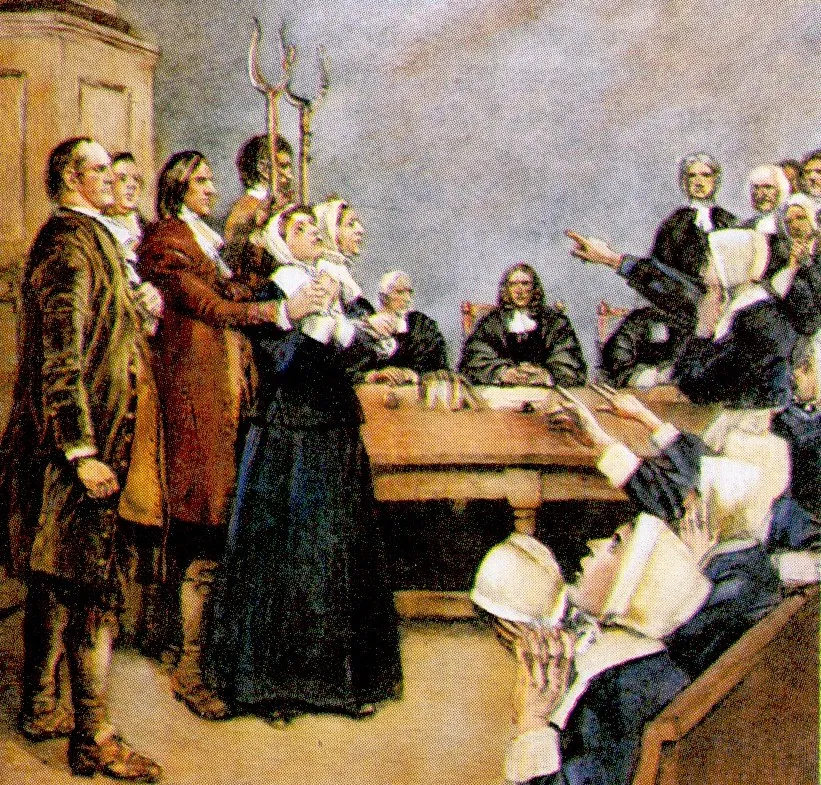 Photo: Salem witch trials, via www.latinamericanstudies.org
The specific accusation — witchcraft — was almost beside the point. Substitute 'communist sympathizer' and you get McCarthy's America. Substitute 'critical race theory' or 'groomer' and you get the current moment. The psychological architecture is identical. Someone controls the definition of the threat, and that control is itself the prize.
Why the Target Always Changes but the Pattern Never Does
If you map out American moral panics chronologically, the targets rotate with almost comedic regularity. Jazz was going to corrupt youth in the 1920s. Comic books were the problem in the 1950s. Rock and roll, then heavy metal, then video games, then internet pornography, then social media. The specific boogeyman gets updated every decade or so, but the underlying claim is always identical: something new is destroying the values that made us who we are, and the people who understand this must act before it's too late.
What never gets examined in these panics is the assumption buried in the premise — that there was a stable, coherent set of values that everyone shared before the corrupting influence arrived. There wasn't. There never is. Cato's 'traditional Roman values' were themselves a constructed mythology. The Puritans' 'godly community' was always internally contested. The 1950s American normalcy that culture warriors keep trying to restore was a specific, temporary, heavily marketed snapshot that excluded most of the actual population.
The golden age being defended is almost always a fiction. But the fight to defend it is very real, and very useful to specific people.
So What Is It Actually About?
Power. Specifically, the power to set the terms of belonging.
In any community — a Roman city-state, a Puritan settlement, a contemporary American suburb — the ability to define what counts as 'normal,' 'decent,' or 'patriotic' is enormous leverage. It determines who's included and who's marginal. It determines whose children are safe and whose are suspect. It determines who gets to sit on the school board and who gets shouted down at the microphone.
Cato the Elder didn't care that much about Greek poetry. He cared about being the man who defined Roman virtue, because that definition was political currency.
Your local school board fight probably isn't really about the specific book getting challenged. It's about who gets to set the terms. Who gets to say what this community is.
Two thousand years of data on this pattern suggests one uncomfortable conclusion: the culture war never ends because it was never about culture. It's a permanent feature of how humans negotiate status and belonging. The specific battlefield changes. The fight doesn't.
Knowing that doesn't make the fight less real or less consequential. But it might make you a little harder to manipulate by whoever's currently holding the microphone.