How Sports Fans Burned Down Constantinople — And Why American Politics Is Following the Same Playbook
When the Game Became Everything
On January 13, 532 CE, Constantinople erupted in flames. For a week, the greatest city in the world burned while citizens slaughtered each other in the streets. The death toll reached 30,000. The cause? A chariot race.
The Blues and the Greens — originally just fan clubs for different racing teams — had evolved into something far more dangerous. They weren't just rooting for horses anymore. They were warring tribes whose identity had collapsed into a single, all-consuming us-versus-them mentality that made compromise impossible and violence inevitable.
Sound familiar?
The Hippodrome's Deadly Logic
Byzantine chariot racing wasn't just entertainment. It was the primary way ordinary citizens participated in public life. The Hippodrome seated 100,000 people — roughly 20% of Constantinople's population — and race days became the only time regular people could directly communicate with the emperor. Fans would chant political demands between races, turning sporting events into impromptu town halls.
This fusion of entertainment and politics created something psychologically toxic. When your team loses, it's not just a game — it's a rejection of your political voice, your social status, your fundamental worth as a citizen. When your team wins, you're not just celebrating athletic success — you're asserting dominance over fellow citizens who suddenly feel like enemies rather than neighbors.
The Blues and Greens stopped seeing each other as fellow Romans who happened to prefer different charioteers. They became existential threats to each other's vision of what the empire should be.
The American Remix
Replace chariots with football, and Constantinople with any American city on Super Bowl Sunday. Replace the emperor with cable news anchors. Replace the Hippodrome with Twitter. The psychological machinery remains identical.
Consider how American political identity now maps almost perfectly onto cultural consumption patterns. Republicans watch Fox News, drive trucks, and listen to country music. Democrats watch MSNBC, buy Priuses, and stream NPR podcasts. These aren't just preferences — they're tribal markers that determine who counts as "real Americans" and who represents an existential threat to the nation's future.
The most telling parallel is how both societies convinced themselves that their factional loyalty was actually principled political philosophy. Byzantine Blues claimed they represented traditional Roman values against Green innovation. Greens insisted they were defending progress against Blue reaction. Both sides developed elaborate intellectual justifications for what was fundamentally tribal thinking.
When Everything Becomes Political
The Nika Riots didn't start with politics. They started when Blues and Greens were arrested for violence after a particularly heated race day. But by 532 CE, there was no such thing as "just sports" in Constantinople. Every chariot victory was a political statement. Every fan chant was a policy position. Every racing controversy became a constitutional crisis.
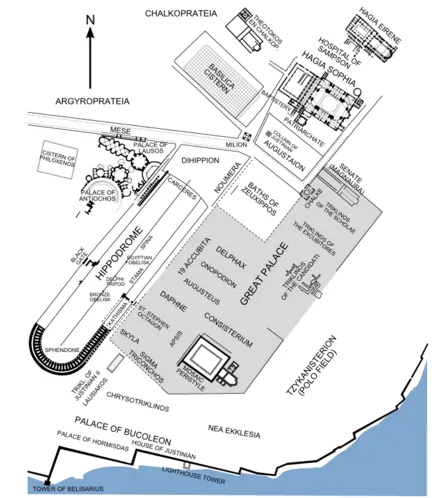 Photo: Nika Riots, via upload.wikimedia.org
This is the pattern that destroys republics: when citizens lose the ability to separate their political identity from their total identity. When supporting a sports team, shopping at certain stores, living in particular neighborhoods, and consuming specific media all become ways of declaring which tribe you belong to — and which tribe you consider your enemy.
Modern Americans have replicated this toxic fusion with impressive precision. Pandemic mask-wearing became a political statement. Coffee shop choices signal party affiliation. Even grocery store preferences map onto electoral outcomes with statistical reliability.
The Escalation Algorithm
What makes this pattern so dangerous is its built-in escalation mechanism. Once politics becomes tribal identity, every policy disagreement becomes an attack on your fundamental self. Compromise feels like surrender. Moderation looks like betrayal.
The Blues and Greens of Constantinople started by throwing food at opposing fans. They escalated to organized brawling. Then coordinated attacks on each other's neighborhoods. Finally, open warfare in the streets with both sides demanding the emperor's abdication.
Each escalation felt justified because the other side had escalated first. Each act of violence was defensive because the other tribe represented an existential threat. By the time reasonable people on both sides realized how far things had gone, the momentum was unstoppable.
The Point of No Return
Historians debate exactly when Byzantine society crossed the line from competitive democracy to tribal warfare. But the warning signs were clear years before the riots: increasing residential segregation by faction, parallel media ecosystems that reported completely different versions of the same events, and the gradual disappearance of citizens who refused to pick a side.
The most ominous parallel is how both societies developed what psychologists call "negative partisanship" — loyalty defined primarily by hatred of the other side rather than positive vision for their own. Late-period Blues cared more about defeating Greens than about any specific policy outcomes. Their entire political identity became organized around preventing the other tribe from winning.
The Republic's Immune System
Healthy democracies have immune systems against tribal thinking. Multiple competing factions prevent any two-sided split. Cross-cutting identities mean citizens belong to different tribes for different issues. Strong institutions maintain legitimacy even when particular leaders lose credibility.
Byzantine Constantinople lost all three protections. American democracy is rapidly losing them too.
The most dangerous moment comes when a society's tribal split aligns perfectly with its geographical, cultural, and economic divisions. When all the Blues live in one part of the city and all the Greens in another. When they shop at different stores, consume different media, and socialize only within their tribe.
That's when sports becomes war, and war becomes inevitable.
Learning from Ashes
The Nika Riots ended when Emperor Justinian ordered his troops to massacre everyone in the Hippodrome, regardless of faction. Thirty thousand citizens died in a single afternoon, and Byzantine democracy never recovered. The empire survived for another thousand years, but as an autocracy that kept its citizens too weak and divided to threaten imperial power again.
This is the historical pattern: when republics split into warring tribes, they don't return to healthy democracy. They either collapse entirely or survive as authoritarian states that suppress the tribal energy that once threatened to destroy them.
The question isn't whether America will follow Constantinople's path. The question is whether we'll recognize the script in time to write a different ending.