You've Been Paying for Inner Peace Since 400 BC — The Price Just Has More Zeros Now

Photo by Photo by Manoa Angelo on Unsplash on Unsplash
You've Been Paying for Inner Peace Since 400 BC — The Price Just Has More Zeros Now
Somewhere right now, a person with a decent salary and a stressful job is spending $400 a night to sleep in a yurt, drink something that tastes like lawn clippings, and listen to a practitioner with a vague credential explain that their nervous system needs to be "reset." They will leave feeling better. The retreat will call this proof that it works.
It is proof of something. Just not what the brochure claims.
The wellness industry in the United States clears somewhere north of $480 billion annually, depending on who's counting and what they're willing to include in the category. Spas, mindfulness apps, detox programs, sound bath studios, float tanks, functional medicine concierges — the delivery mechanisms keep multiplying. But the underlying transaction has been stable for about two and a half thousand years, and ancient Greece left us the receipts.
What the Asclepieia Actually Were
The Greeks built dedicated healing sanctuaries called Asclepieia — named for Asclepius, the god of medicine — at dozens of sites across the ancient world. The most famous was at Epidaurus, which operated continuously for centuries and drew visitors from across the Mediterranean. These weren't hospitals in any modern sense. They were something closer to what we'd now call a destination wellness retreat, and they ran on a business model that would make a Sedona resort operator nod in recognition.
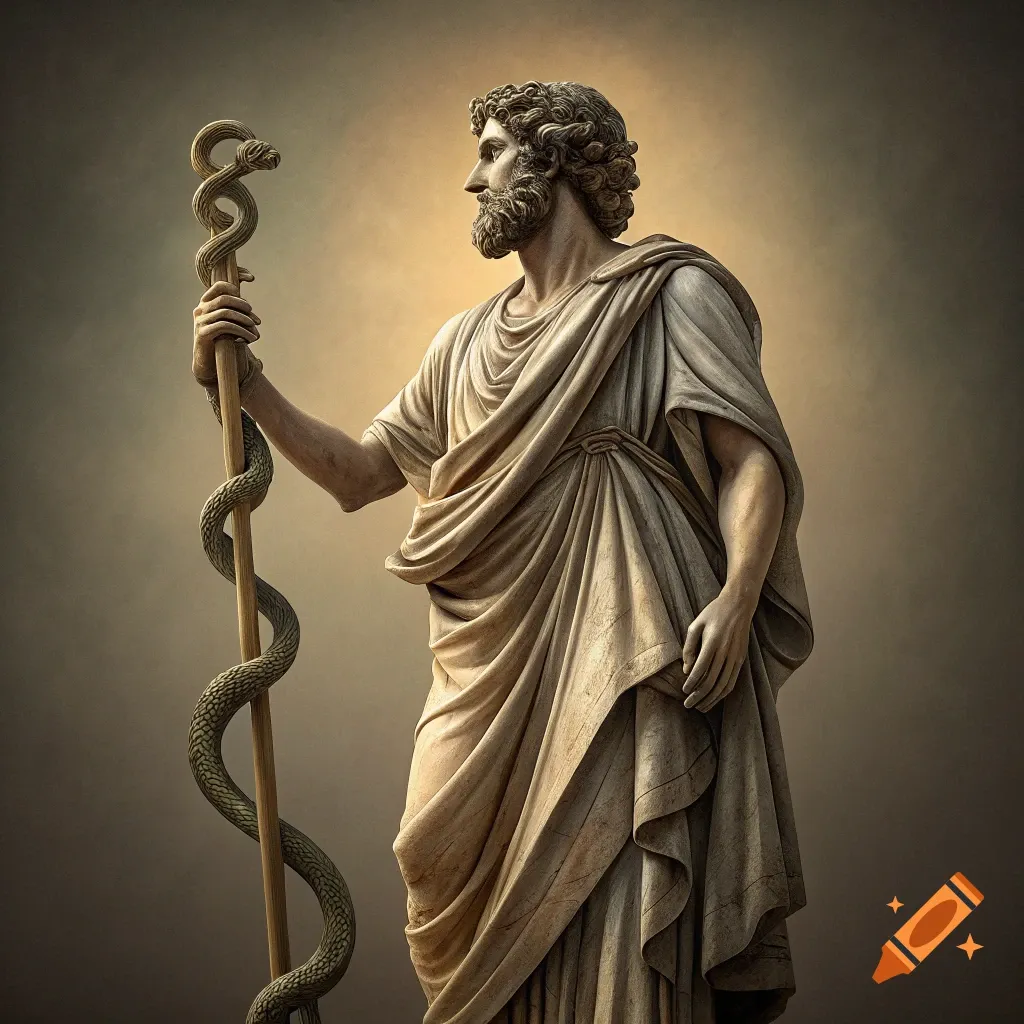 Photo: Asclepius, via media.craiyon.com
Here's how it worked. You arrived feeling unwell — physically, mentally, or spiritually, categories the Greeks didn't sharply separate. You paid an entry fee. You underwent a purification ritual, which typically involved fasting, bathing, and abstaining from sex. You were then guided into a special sleeping hall called the enkoimeterion, where, after appropriate preparation, you were expected to receive a healing dream from Asclepius himself. Priests interpreted the dream. You followed the prescribed treatment. You paid a departure offering scaled to your means — though "scaled to your means" in practice meant the wealthy paid substantially more and got substantially better accommodations.
Isolation from ordinary life. Ritual preparation. Expert intermediaries between you and the healing force. Premium pricing. A personalized prescription delivered by someone with institutional authority. The structure is not analogous to modern wellness retreats. It is identical to them.
The Anxiety Extraction Machine
Here's the part that doesn't make it into the marketing copy: the Asclepieia didn't just treat anxiety. They were partly sustained by it.
The ancient Mediterranean world was genuinely stressful — plague, war, economic precarity, political instability. The sanctuaries offered something that everyday life couldn't: a bounded space where your suffering had structure, expert attention, and a promised resolution. The fact that some people got better is real. Placebo effects are real. Rest, decent food, and removal from stressors produce measurable physiological changes. None of that is fake.
But the business model required that healing remain mysterious enough to justify the intermediary. If you could heal yourself at home, you didn't need the priests. If the dream interpretation was straightforward, you didn't need years of priestly training to decode it. The expertise had to be legible enough to inspire confidence and opaque enough to remain indispensable. Sound familiar? That's the same tension running through every functional medicine practice, every certified breathwork facilitator, every app that charges $19.99 a month to teach you how to inhale.
Class Was Always the Subtext
The Asclepieia were technically open to everyone, and ancient sources make a point of this. In practice, the experience you got scaled sharply with what you could pay. Wealthier visitors got private accommodations, more personalized priestly attention, and better food during their stay. Poorer visitors got the general facilities.
This maps so cleanly onto the modern wellness landscape that it barely needs commentary. The basic meditation app is technically available to anyone with a smartphone. The silent retreat in the Berkshires with private chef-prepared meals and a personal integration coach is available to a much narrower slice of the population. The rhetoric of wellness is almost always universalist — healing is for everyone, you deserve rest, your body is worthy of care. The pricing structure tells a different story.
What the historical record shows, consistently, is that the commodification of healing has always served a dual function. It provides genuine relief to some people some of the time. And it provides a socially acceptable way for the economically comfortable to convert money into status, identity, and the feeling that they are taking their inner life seriously in a way that less wealthy people cannot quite manage.
The Ritual Does Real Work — That's What Makes It Complicated
None of this means the wellness industry is a pure scam. That's actually the more interesting finding. The Asclepieia produced documented cures — stone tablets at Epidaurus record hundreds of them, including conditions that look in retrospect like psychosomatic illness responding to the ritual structure of the cure. Modern research on placebo effects, on the therapeutic value of structured rest, on the measurable impact of social ritual on stress hormones — all of it suggests that what was happening at these sanctuaries wasn't nothing.
The human brain responds to the experience of being cared for in a special place by specially trained people. It has done this for as long as we have records of human psychology, which is to say, for as long as we have records of anything. The ritual container does something real, even when the specific mechanism is nonsense.
The problem isn't that the yurt retreat doesn't help anyone. The problem is that we've built an industry around the premise that healing requires removing yourself from ordinary life and paying credentialed strangers to facilitate your return to yourself — and we treat this as a discovery, a modern solution to a modern problem, rather than a very old business that has learned to speak the language of whatever era it's operating in.
What Five Thousand Years of Healing Markets Actually Tell Us
The Asclepieia eventually declined, not because people stopped getting anxious or sick, but because Christianity reorganized the healing landscape around a different set of institutions with a different set of intermediaries. The medieval pilgrimage site, the healing shrine, the monastery with its medicinal gardens — same structure, different branding. The Enlightenment secularized the whole apparatus into spas and hydrotherapy clinics. The twentieth century gave us the sanitarium, the wellness retreat, the therapy industry. The twenty-first century digitized it.
At every stage, the core transaction remained: you pay someone to hold structured space for your distress, and the act of paying is itself part of what makes the relief feel legitimate.
That's not cynicism. It's psychology. And the Greeks understood it well enough to build stone temples around it that lasted for centuries.
The next time a wellness brand tells you they've cracked the code on healing, you might ask them how Epidaurus is doing. It's a UNESCO World Heritage Site now. The tourists seem to find it very peaceful.