Chariot Colors and Culture Wars: How Byzantium Turned Identity Into a Weapon for a Thousand Years
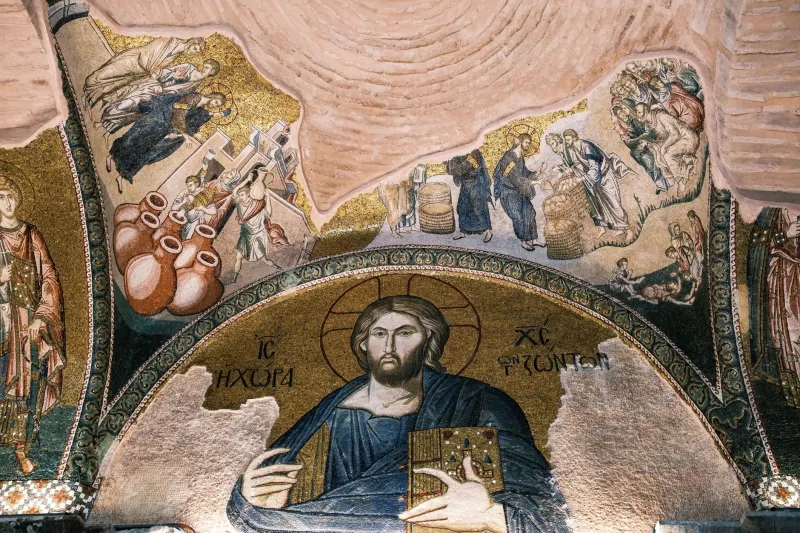
Here's a sentence that sounds like it was written last Tuesday: a superpower fractured along cultural, religious, and regional lines, with ordinary people willing to riot, burn buildings, and disown family members over conflicts that had almost nothing to do with their actual material lives. The elites in charge learned to stoke those conflicts because an angry population focused on the wrong enemy is a manageable population.
That sentence was not written last Tuesday. It describes the Byzantine Empire across roughly a thousand years of recorded history. And if you think the parallel to contemporary American life is a coincidence, you haven't been paying attention to what five thousand years of data actually shows us about human psychology.
It Started With Chariot Racing (No, Really)
The Byzantine Empire inherited Rome's circus factions — organized fan clubs built around chariot-racing teams, identified by color. The Blues and the Greens were the big ones. By the time Constantinople was the center of the known world, these factions had evolved into something that looked less like a sports fan club and more like a cross between a political party, a street gang, and a religious movement.
People were born into their faction. They married within it. They rioted for it. In 532 CE, Blues and Greens briefly united against Emperor Justinian in what became known as the Nika Riots — five days of urban warfare that killed somewhere between 30,000 and 50,000 people and burned half of Constantinople to the ground. The immediate trigger was a chariot race. The actual fuel was decades of economic grievance, political resentment, and the very human need to have a tribe that tells you who you are.
 Photo: Nika Riots, via www.worldhistoryedu.com
Justinian's response, once his general Belisarius had slaughtered the rioters in the Hippodrome, was instructive: he kept the factions. He didn't dissolve them. He weaponized them. A divided population is harder to organize against you.
The Theology Was Never Really About Theology
Byzantium is famous — or infamous — for its theological disputes. Iconoclasm. Monophysitism. The filioque controversy. Generations of historians have written millions of words about whether Byzantine citizens genuinely cared whether Christ had one nature or two, or whether the Holy Spirit proceeded from the Father alone or from the Father and the Son.
The short answer, backed by the historical record, is: sometimes, a little, but mostly no.
What the theological disputes actually mapped onto was regional identity, ethnic belonging, and economic competition. The Monophysite heresy — the belief that Christ had a single, divine nature rather than two — was overwhelmingly concentrated in Egypt, Syria, and the eastern provinces. Those were also the provinces that resented Constantinople's tax extraction, felt culturally distinct from the Greek-speaking capital, and had grievances that had nothing to do with Christology.
The theology was a flag. It told you which team someone was on without requiring anyone to say the quiet parts out loud. Sound familiar? It should. The mechanism — using a symbolic cultural marker as a proxy for an underlying tribal identity rooted in economic anxiety — is not a Byzantine invention. It's a feature of human social cognition that shows up every time a complex society develops enough internal tension to need a release valve.
How Byzantine Emperors Learned to Play the Game
The smarter Byzantine emperors figured out something that modern political consultants have independently rediscovered: you don't need to solve people's problems if you can redirect their anger. You just need a convincing enemy.
Emperor Leo III launched the Iconoclast movement in 726 CE — ordering the destruction of religious images — and historians still argue about his actual motivations. Some say he was theologically sincere. Others point out that the Iconoclast policy conveniently allowed him to seize enormous wealth from monasteries, undercut the political power of the church, and unify his military class (who were disproportionately from image-skeptical eastern provinces) against the Roman papacy and the monk-heavy western establishment.
The population spent the next century and a half in violent, sometimes lethal disagreement about whether a painting of a saint constituted idolatry. The emperor's treasury got fuller. The church's political independence got weaker. The actual economic conditions that made ordinary Byzantines miserable — tax burdens, military conscription, grain prices — went largely unaddressed.
This is not a conspiracy theory. It's just what the historical record shows when you ask the right question: who benefited?
The Psychological Machinery Underneath
Here's where the science comes in, because the history only tells you what happened. The psychology tells you why it keeps working.
Human beings are tribal by deep evolutionary design. We categorize ourselves and others constantly, and we derive genuine psychological comfort from group membership — even when the group is arbitrary. Henri Tajfel's classic social identity experiments in the 1970s showed that people would favor in-group members and disadvantage out-group members even when the groups were formed by coin flip. Completely meaningless group assignment produced real discriminatory behavior within minutes.
Now imagine you're not sorted by a coin flip. You're sorted by something that feels cosmically significant — your religious belief, your cultural identity, your regional heritage. The in-group loyalty and out-group hostility get dramatically stronger. And if you're an emperor, or a political operative, or anyone whose power depends on preventing a broad coalition from forming against you, that tribalism is an extraordinary tool.
Byzantium ran this experiment for a thousand years. The factions changed names and symbols. The theological controversies rotated. The underlying machinery — identity-based conflict serving as a pressure valve for economic and political grievance — stayed remarkably constant.
This Isn't an Argument for Cynicism
The point here isn't that every cultural conflict is fake, or that ordinary people who feel strongly about cultural issues are rubes being manipulated. That's too simple, and it's also historically wrong. Real things were at stake in Byzantine theological disputes — community identity, local autonomy, the distribution of institutional power. Real things are at stake in contemporary American culture conflicts too.
The point is that the form these conflicts take — the intensity, the tribalism, the willingness to prioritize symbolic victories over material ones — is not a product of modern media or smartphone algorithms or any other recent invention. It's what happens when human social psychology meets political actors who understand how to use it.
Byzantium didn't invent the culture war. But it did run the longest controlled experiment in recorded history on how one works, what sustains it, and what it ultimately costs the societies that can't find their way out of it. Constantinople fell in 1453. The Blues and the Greens had been gone for centuries by then, but the habit of mind they represented never really left.
We've got five thousand years of data on this pattern. The question is whether we're going to use it.